Non Surgical vs Surgical Aesthetic Procedures in Saudi Arabia. How to Decide What Is Right for You?
Most aesthetic concerns in Saudi Arabia can be addressed both surgically and non-surgically. The right choice depends on how much change you want, how much downtime you can accept and how long you want the result to last.
The aesthetic industry in Saudi Arabia has seen rapid growth in non-surgical treatments over the past three years. Botox, dermal fillers, thread lifts, body contouring devices and laser treatments now account for a significant portion of clinic revenue across Riyadh. Many patients prefer to start here — lower commitment, no anesthesia, no visible recovery time. But for some concerns, non-surgical treatments are a short-term solution to a problem that only surgery can permanently address.
This guide does not recommend one over the other. It explains what each approach can and cannot do, and where the clinical evidence sits in 2026.
The Core Difference Between Surgical and Non-Surgical Approaches
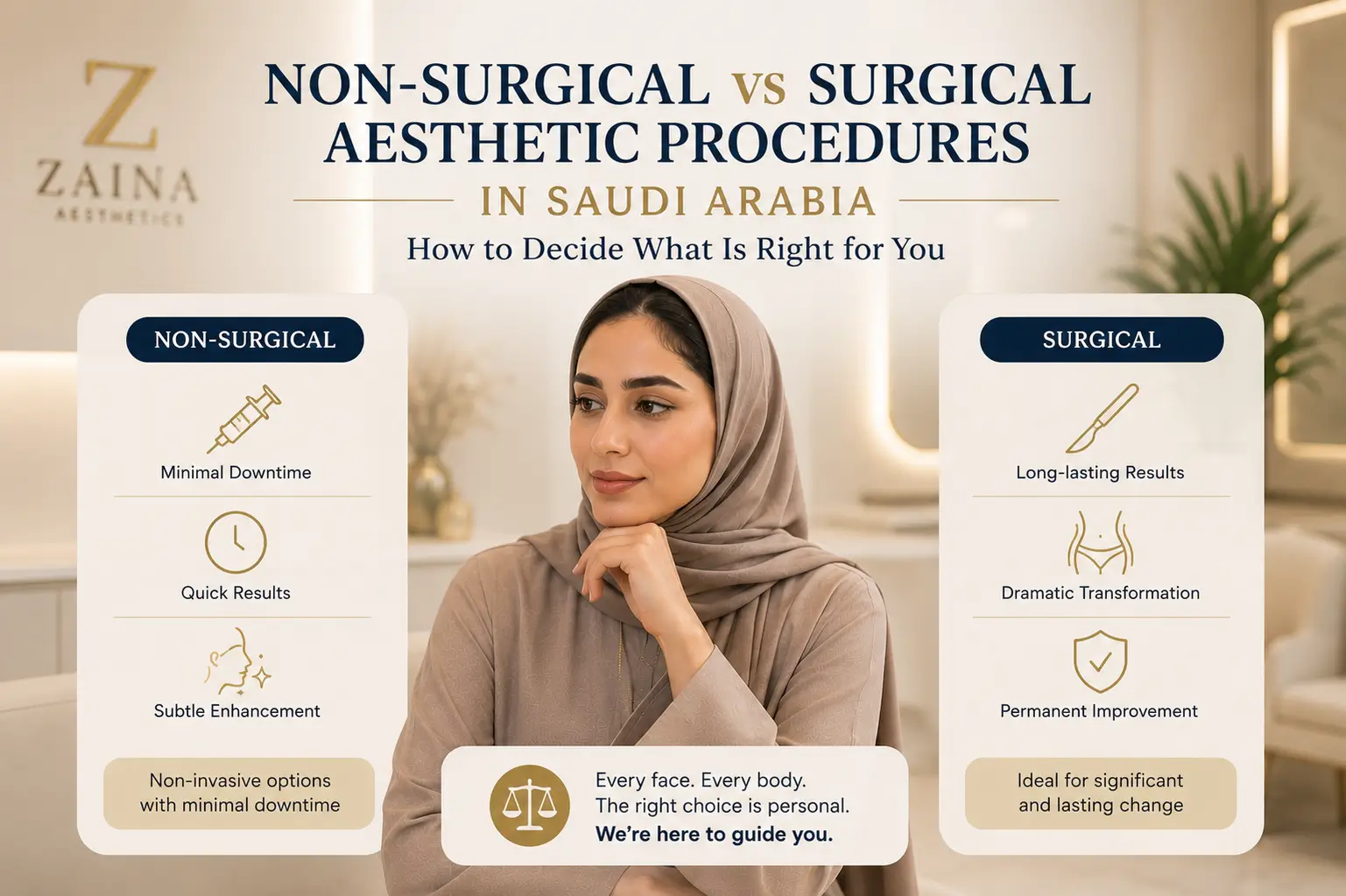
Non-surgical and surgical aesthetic procedures differ in terms of results, recovery time, cost, and longevity. Non-surgical treatments provide subtle, natural-looking improvements with little to no downtime, making them a suitable choice for patients seeking gradual enhancements. However, the results are temporary and usually require maintenance sessions. Surgical procedures offer more significant and longer-lasting changes, often with permanent results, but they involve higher costs, a longer recovery period, and greater risks due to their invasive nature. Choosing between the two depends on your goals, budget, and the outcome you want to achieve.
The Most Common Non-Surgical Treatments Available in Riyadh
Botulinum Toxin (Botox)
Used for dynamic wrinkles — forehead lines, crow's feet, frown lines. Also used for brow lift, lip flip and jaw slimming (masseter reduction). Duration: 3–6 months. Cost: SAR 800–2,500 per area. Requires repeat sessions to maintain results.
Dermal Fillers (Hyaluronic Acid)
Used for volume restoration — cheeks, lips, tear troughs, nasolabial folds. Can also be used for non-surgical rhinoplasty (temporary nose reshaping). Duration: 12–18 months. Cost: SAR 1,500–4,000 per area. Cannot create results equivalent to surgical augmentation for significant volume loss.
Thread Lift
Dissolvable threads inserted under the skin to lift sagging tissue — jowls, mid-face, brows. Results are modest and last 12–18 months. Best for patients with early-stage laxity who want to delay surgery. Not a substitute for facelift in patients with significant sagging.
Body Contouring Devices (EMSculpt, CoolSculpting, BodyTite)
Non-surgical fat reduction and muscle definition. Best for mild to moderate fat in specific areas. CoolSculpting (LipoCryo) starts from SAR 945 per session. Multiple sessions needed. Volume of fat removed is significantly less than surgical liposuction.
When Non-Surgical Is Not Enough — Knowing the Limit
Non-surgical treatments have a ceiling. For the following concerns, surgery is the only approach that delivers the result patients typically want:
Significant excess skin — after weight loss, post-pregnancy, or age-related laxity — fillers and threads cannot remove tissue
Large volume changes — breast augmentation of more than one cup size requires an implant
Nasal reshaping beyond minor contouring — surgical rhinoplasty is required for structural changes to cartilage and bone
Permanent fat removal across multiple areas — liposuction removes fat permanently; devices reduce it modestly and temporarily
Diastasis recti — separated abdominal muscles after pregnancy cannot be repaired by any non-surgical means
The Saudi Market Context — Why Non-Surgical Has Grown
Several factors specific to Saudi Arabia have driven growth in non-surgical treatments in Riyadh:
Faster adoption among younger patients (25–35) who want early preventative treatment without surgical commitment
Cultural preference for gradual, undetectable improvement — results that go unnoticed are valued
Work and lifestyle constraints — minimal downtime is a practical preference for working professionals
Growing awareness of non-surgical options through social media, specifically Instagram and TikTok in Arabic
Not sure whether a non-surgical or surgical approach is right for your specific concern? Describe it to Ask Zaina — unbiased guidance, no clinic recommendation.
Frequently Asked Questions
Q: Can I combine non-surgical and surgical treatments?
A: Yes — this is common in Riyadh. Many patients have Botox and fillers maintained alongside surgical procedures. The timing must be managed carefully — inform all treating practitioners of everything you are currently having done.
Q: Are non-surgical treatments halal in Islam?
A: Most Islamic scholars permit non-surgical aesthetic treatments for legitimate psychological benefit. The ruling broadly parallels that for cosmetic surgery. Consult a scholar you trust for your personal situation.
Q: Is it true that fillers can complicate future rhinoplasty?
A: Yes. Multiple filler sessions in the nose create scar tissue around the material that makes future rhinoplasty more complex. If you are considering surgical rhinoplasty in the future, limit nasal filler sessions or avoid them entirely.